Possibilities to stuff in the back of the drawer for when you have enough money for a drawing room redo. Design drawings from the Danhauser Workshop, Vienna. 1814-1840. Makers of furniture loved by both Adolf Loos and Josef Hoffmann which says much. From the archives of the MAK (Museum of Applied Arts).

Library. 1831-1840.
Library. 1831-1840. Watercolor and graphite on paper. Studio of Josef Franz Danhauser, maker. Image © MAK – Museum of Applied Arts. Fair use license. via https://sammlung.mak.at/en/collection_online?id=collect-127608
"Design for four candelabras." 1814-1829.
“Design for four candelabras.” 1814-1829. Graphite and pen and ink. Workshop of Joseph Ulrich Danhauser, Vienna. Image © MAK – Museum of Applied Arts, Vienna. Fair use license. viahttps://sammlung.mak.at/en/collection_online?id=collect-129251
"Design for a toilet table." 1814-1829.
“Design for a toilet table.” 1814-1829. Pen and ink drawing. Workshop of Joseph Ulrich Danhauser, maker. Image © MAK – Museum of Applied Arts, Vienna. Fair use license. via https://sammlung.mak.at/en/collection_online?id=collect-129343
"Design for an interior." 1814-1829.
“Design for an interior.” 1814-1829. Pen and ink drawing with graphite. Wash technique. Workshop of Joseph Ulrich Danhauser, maker. Image © MAK – Museum of Applied Arts, Vienna. Fair use license. via https://sammlung.mak.at/en/collection_online?id=collect-127569
"Design for a window drapery." 1814-1829.
“Design for a window drapery.” 1814-1829. Pen and ink with graphite on paper. Workshop of Joseph Ulrich Danhauser, maker. Image © MAK – Museum of Applied Arts, Vienna. Fair use license. via https://sammlung.mak.at/en/collection_online?id=collect-127477
"Design for a tea table." 1814-1829.
“Design for a tea table.” 1814-1829. Watercolor, graphite and pen and ink. Workshop of Joseph Ulrich Danhauser, maker. Image © MAK – Museum of Applied Arts, Vienna. Fair use license. via https://sammlung.mak.at/en/collection_online?id=collect-130021

Artistry to swoon for by Gustav Klimt in his young artist days before he heaped the gold on with a trowel. Austrian. Living from 1868-1918 he made good use of the jewelry engraving skills he learned at his father’s knee. Member of the Viennese Secession.

"Médecine." (Hygieia). 1900-1907.
“Médecine.” (Hygieia). 1900-1907. Oil on canvas. In the public domain in the United States because the artist has been dead over 70 years. via http://www.sohu.com/a/254846320_658882
"Allegory of Sculpture." 1889.
“Allegory of Sculpture.” 1889. Graphite, watercolor and gold. In the public domain in the United States because the artist has been dead over 70 years. via https://phillipkay.wordpress.com/2016/08/12/poetry-and-poets-in-translation/
"Pallas Athena." 1898.
“Pallas Athena.” 1898. Oil on canvas. In the public domain in the United States because the artist has been dead over 70 years. via http://ludwig-mies-vanderrohe.blogspot.com/2011/10/gustav-klimt-part-1.html

Sterling silver with tendrils that crawl up the side and flower. Austrian Dagobert Peche, metalworker. Living from 1887 to 1923 he was a member of the Wiener Werkstätte with Josef Hoffman and Koloman Moser.

Box in the Shape of an Apple. ca.1920.
Box in the Shape of an Apple. ca. 1920. In the public domain in the United States because the artist has been dead over 70 years. via https://venetianred.wordpress.com/2009/07/28/dagobert-peche-genius-of-ornament/
Four large candlesticks. Early 20th c.
Four large candlesticks. Each on four bowl feet and curved strings with corn, grapes and birds. Early 20th c. Forged and chased iron with silver paint. Image © Deutsch Auktionen, Vienna. Fair use license. via https://www.invaluable.com/auction-lot/dagobert-peche-1887-1923-circle-four-large-can-282-c-a8b4b93bd7
Melon shaped box, model number S5159. ca. 1920.
Melon shaped box, model number S5159. ca. 1920. Silver with a partial gilt interior. Image © Neue Galerie New York. Fair use license. via https://www.neuegalerie.org/content/melon-shaped-box-model-no-s-5159
Vase.  ca. 1920.
Vase. ca. 1920. Image © Cooper Hewitt Museum, New York. Fair use license. via https://www.cooperhewitt.org/2017/04/16/playful-exuberance-dagobert-peches-silver-vase/
Bird shaped candy box. ca. 1920.
Bird shaped candy box. ca. 1920. Silver with coral eyes. In the public domain in the United States because the artist has been dead over 70 years. via https://venetianred.wordpress.com/2009/07/28/dagobert-peche-genius-of-ornament/

Brooches to set off anyone’s black sweater by Wiener Werkstätte co founder and master designer Josef Hoffmann.

1910.
1910. Executed Karl Ponocny for the Wiener Werkstätte. Gold, mother of pearl and precious stones. Private collection, Fair use license. Photo credit: Decorative Arts Consult. via https://artinwords.de/jugendstil-schmuck-aus-europa/
1908-1910.
1908-1910. Fair use license. via https://domeniquemora.blogspot.com/2013/02/josef-hoffmann-work-of-art.html
Necklace. 1909.
Necklace. 1909. Silver with mother of pearl and evidence of gold plating. Fair use license. via https://www.masterart.com/artworks/5248/josef-hoffmann-wiener-werkstatte-necklace

Having been begged for more Koloman Moser reappears . .. .these he must have rolled up and stuck in the chandelier just for you and me.

Illustration for a child's picture book. 1904.
Illustration for a child’s picture book. 1904. Collage, ink, pencil and colored pencil on paper. Private collection. via https://commons.wikimedia.org/wiki/File:Kolo_Moser_-_Bilderbuch11_-_1904.jpeg
Cover design for the 1898 founder's edition of Ver Sacrum.
Cover design for the 1898 founder’s edition of Ver Sacrum. Letterpress in metallic blue on red. Private collection. via https://upload.wikimedia.org/wikipedia/commons/thumb/9/91/Kolo_Moser_-_Tanzende_Mädchen_-_1898.jpeg/983px-Kolo_Moser_-_Tanzende_Mädch
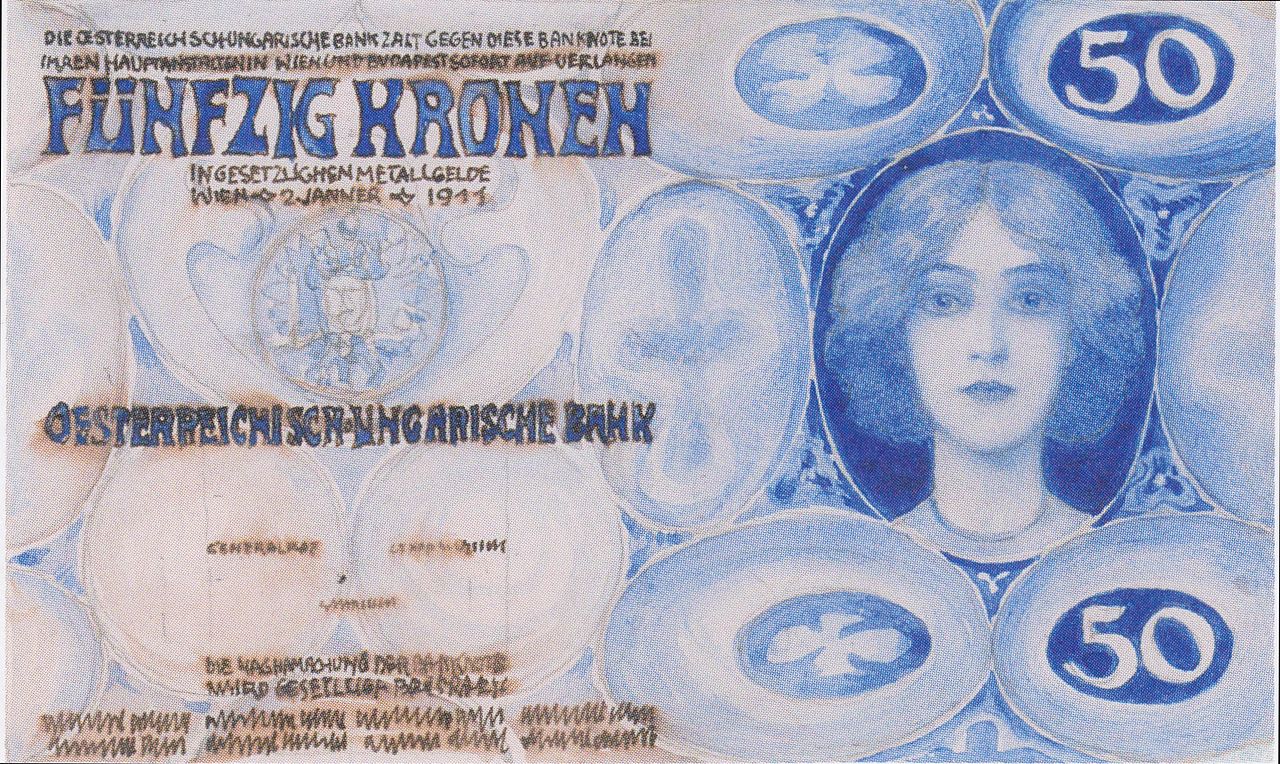
Design for a 50 kroner banknote. 1911.
Design for a 50 kroner banknote. Watercolor on paper. Collection of the Österreichische Nationalbank, Geldmuseum. via https://upload.wikimedia.org/wikipedia/commons/thumb/c/cc/Kolo_Moser_-_50_Kronen-Banknote_-_1911.jpeg/1280px-Kolo_Moser_-_50_Kronen-Banknote_-_1911.jpeg
Design for a 100 kronen note. 1910.
Design for a 100 kronen note. 1910. Watercolor on paper. Collection of the Österreichische Nationalbank, Geldmuseum. via https://commons.wikimedia.org/wiki/File:Kolo_Moser_-_Port%C3%A4t-Entwurf_-1910.jpeg
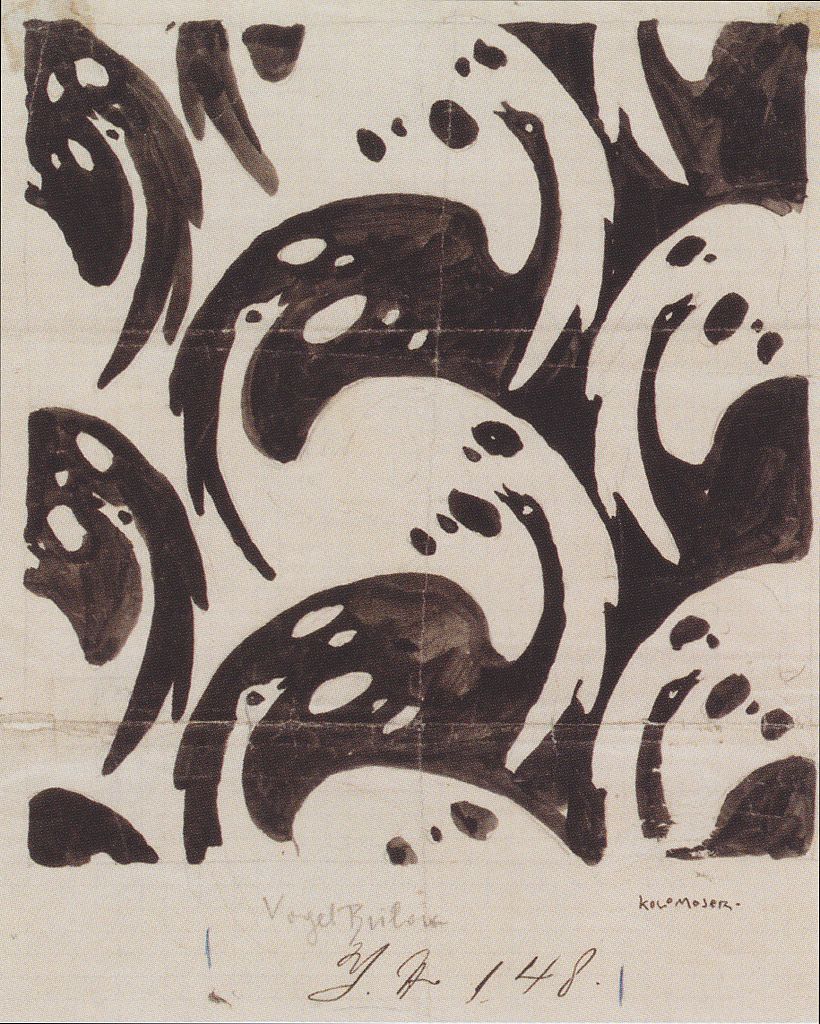
"Vogel Bülow" textile design. 1899.
“Vogel Bülow” textile design. 1899. Pencil and watercolor on paper. Designed for Backhausen. Fa. Backhausen Interior Textiles Archives. via https://upload.wikimedia.org/wikipedia/commons/thumb/0/09/Kolo_Moser_-_Vogel_B%C3%BClow_-_1899.jpeg/820px-Kolo_Moser_-_Vogel_B%C3%BClow_-_1899.jpeg.
Design for a mosaic for the main altar, Church Am Steinhof. 1905.
Design for a mosaic for the main altar, Church Am Steinhof. 1905-06. Pencil, ink and gouache on canvas. Collection of the Museum of Applied Arts, Vienna. via https://commons.wikimedia.org/wiki/File:Kolo_Moser_-_Kirche_am_Steinhof_-_Hauptaltar.jpeg.

All artwork is in the public domain in the United States because the artist has been dead over 70 years.

Three princesses just slightly overdressed (and their pets).

Archduchess Maria Teresa of Austria (and her pet bird) 1771.
Archduchess Maria Teresa of Austria. 1771. Niece of the slightly more famous Marie Antoinette. Anton Raphael Mengs, artist. Image in the public domain. via commons.wikimedia.org.
Unknown Polish princess of the Vasa dynasty in Spanish costume (and her dog). ca. 1644.
Unknown Polish princess of the Vasa dynasty in Spanish costume. ca 1644. Peeter Danckers de Rij, artist. Artwork in the public domain. via commons.wikimedia.org.
Carlota Joaquina de Bourbon, Queen of Portugal and Princess of Spain. 1785.
Carlota Joaquina de Bourbon, Queen of Portugal and Princess of Spain. 1785. Mariano Salvador Maella, artist. Collection of the Prado National Museum. Artwork in the public domain. via commons.wikimedia.org.